Which Content Strategies Work Best for AI Discovery?
· ~9 min read
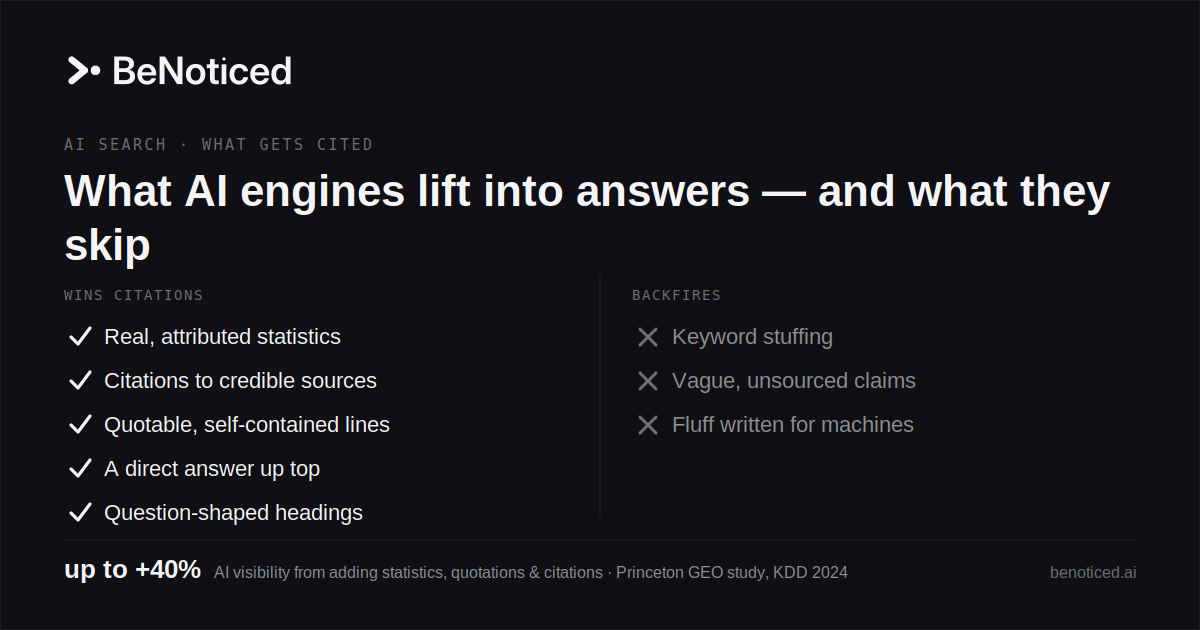
The content strategies that most reliably earn AI citations are the ones that make your claims easy to lift and easy to verify: a direct answer in the first two sentences, real statistics with named sources, self-contained sentences that survive being quoted out of context, and question-shaped headings that mirror how people actually prompt. In the largest academic study on this — Princeton's Generative Engine Optimization paper (Aggarwal et al., KDD 2024) — adding statistics, quotations, and citations to a page boosted its visibility inside AI answers by up to 40% across 10,000 queries.
But here is the part most "AEO checklists" leave out: which of those tactics actually moves the needle depends on the engine, the topic, and your brand's existing authority — and it shifts month to month. So the winning approach is not a fixed list you apply once. It's a measured loop: publish extractable content, track your citation share per engine, and double down on what gets cited for you.
Key takeaways
- Extractability wins the scarce citation slots. An AI answer cites roughly 2–7 sources, not ten blue links. Among equally relevant pages, the one that's specific, sourced, and quotable gets pulled in.
- Real statistics and cited sources are the single highest-leverage additions — and citing others makes you more citable. Never invent a number to do this.
- Ranking #1 on Google no longer guarantees an AI citation. Independent 2026 studies put the overlap between Google's organic top 10 and AI citations anywhere from ~12% to ~38%, down from ~76% a year earlier.
- Each engine sources differently. Perplexity retrieves live on every query; ChatGPT without browsing answers from model memory; Gemini and Google AI Overviews lean on Google's index. One page can win on one engine and be invisible on another.
- Being mentioned is not being recommended. Optimizing for citation volume alone can make you feel visible while a competitor is the one being picked.
- You can't run this open-loop. The only way to know which strategy works for your brand is to measure citation share across engines over time — the AI-search equivalent of Google Search Console.
What does "AI discovery" actually mean?
AI discovery is whether — and how — your brand shows up when someone asks a question inside an AI answer engine like ChatGPT, Perplexity, Google AI Overviews, Gemini, or Microsoft Copilot, instead of typing a keyword into a search box. The surface is no longer a ranked list of links; it's a synthesized paragraph or two with a handful of embedded citations. If you're one of those citations, you exist in that answer. If you're not, the user never sees your page.
This is why the field picked up its own labels — AEO (answer engine optimization) and GEO (generative engine optimization). They describe the same goal: earning a place inside the generated answer, not just the links beneath it.
Why doesn't ranking #1 on Google get me cited anymore?
Because AI answers no longer draw mainly from the organic top 10. The relationship has weakened sharply and fast. An Ahrefs analysis of 863,000 keywords and 4 million AI Overview URLs found that only 38% of cited pages also ranked in Google's organic top 10 for the same query — down from 76% in its July 2025 run (as reported by Search Engine Journal, which also notes part of that drop reflects better citation detection, so the two waves aren't perfectly comparable). BrightEdge put the top-10 overlap closer to 17% in early 2026, and Moz's February 2026 study of roughly 40,000 queries found only 12% of Google AI Mode citations matched a top-10 organic URL — meaning about 88% of the pages AI Mode cites sit outside the results a rank tracker even monitors.
The mechanism behind this is query fan-out: the model splits one question into several sub-questions and pulls sources for each. Covering a topic thoroughly across the related angles a reader would ask next now carries more weight than holding a single top-10 position. Ranking still helps — Google AI Overviews lean on the classic index far more than standalone chatbots do — but rank alone is a weak predictor of citation.
Which content tactics have actually been tested?
The Princeton GEO study remains the most rigorous public test of what drives visibility inside AI answers. It ran ~10,000 queries across nine domains and measured nine content changes. The findings that hold up:
- Adding statistics, quotations, and citations produced the largest lifts — up to ~40% more visibility, with each tactic worth roughly 25–40% depending on the metric and domain.
- Citations act as an equalizer. Pages sitting outside the top spots gained the most; a page at position 5 saw over 100% higher visibility after adding proper source attribution. If you're not already dominant, this is your lever.
- Keyword stuffing hurt. The classic SEO reflex performed about 10% worse than the untouched baseline on Perplexity.
- Fluency plus statistics was the strongest combination — clear writing on its own did little, but paired with concrete numbers it beat every single tactic.
A useful corrective arrived with C-SEO Bench (Puerto et al., 2025), the first systematic benchmark of "conversational SEO" tricks. Its blunt conclusion: most prompt-engineering-style tactics don't help, and several backfire, while plain source relevance keeps working. The lesson isn't "tactics don't matter" — it's that tactics only pay off on top of genuinely relevant, useful content. Extractable junk still doesn't get retrieved.
Do the tactics change by engine?
Yes — enough that "optimize for AI search" as a single channel is a mistake. The engines run different retrieval architectures, search different indexes, and cite different numbers of sources per answer.
| Engine | How it sources answers | What that means for your content |
|---|---|---|
| Perplexity | Retrieval-first: live web search on every query, high citation density, cites inline. | Fastest to reflect newly published or updated pages; rewards specificity, structure, and recency. Publish and refresh often. |
| ChatGPT | Without browsing, answers from training memory (no live sources); with search, fetches ~10–20 pages and cites the top 2–4. | Wider web reputation shapes how it talks about you even when it doesn't cite a page. Consistent brand presence across the web matters. |
| Google AI Overviews | Grounded in Google's core index and ranking; explicit query fan-out. | Closest to classic SEO — crawlability, helpfulness, and freshness still dominate. Cover topics in depth, not single keywords. |
| Gemini | Search-grounded through Google's index and infrastructure. | Overlaps heavily with AI Overviews guidance; strong Google-side fundamentals carry over. |
| Microsoft Copilot | Leans on the Bing index. | Make sure the site is indexed in Bing Webmaster Tools, not only Google. Strong in enterprise and procurement contexts. |
Sources: Search Engine Land on retrieval architectures; MR Research on per-engine source-selection.
The practical consequence: a page Perplexity loves has no guaranteed path to being cited by ChatGPT or Google AI Overviews. Each has to be checked on its own terms.
The tactic most checklists miss: mentioned isn't recommended
Here's the distinction we watch most closely at BeNoticed, because it's the one brands miss when they chase raw citation counts. Being mentioned in an answer is not the same as being recommended by it. An engine can list you among five options and still steer the user toward a competitor in the same breath. Citation rate and recommendation rate are genuinely different metrics — different signals, different denominators — and a content strategy that lifts one can leave the other flat.
There's a second nuance behind the numbers: not every mention is grounded in your content. In our scans, Perplexity tends to cite from real, retrievable pages, while ChatGPT and Claude will often mention a brand from what the model already "knows" — no source attached. That changes the play. Winning a Perplexity citation is a content problem you can solve on your own page this week. Being the brand the models remember is a slower, wider reputation problem — earned across third-party coverage, reviews, and consistent information about your brand everywhere it appears.
So what's the actual strategy?
Do the extractable-content fundamentals well, then measure and iterate. Concretely:
- Lead every page with a direct, standalone answer to the question it targets. Skimmers, snippets, and extractive AI all grab the top.
- Replace vague claims with real, attributed numbers. "Cut onboarding from 9 days to 2" earns a citation; "significantly faster onboarding" doesn't. If you don't have the number, find a credible source or write the point qualitatively — never invent one.
- Cite credible outside sources. Linking to research and primary data signals rigor and, per the Princeton study, makes your own page more citable.
- Write self-contained sentences. Name the subject instead of leaning on "it" and "this," so a quoted line still means something on its own.
- Shape headings as real questions and answer the fan-out — the follow-up questions a curious reader would ask next — in tight 2–4 sentence blocks. An FAQ section is ideal.
- Keep it fresh. Several engines favor recently published or updated content; a page left to age quietly loses citation share.
- Measure citation share per engine, over time. This is the step almost everyone skips. Test your target prompts across ChatGPT, Perplexity, Gemini, and Google AI Mode and track whether — and how — your brand appears versus competitors. That's the AI-search equivalent of Search Console, and it's the only way to tell which of the tactics above are actually working for you. This is precisely the job an AI visibility tracker does: BeNoticed runs your prompts across ChatGPT, Claude, Gemini, and Perplexity, shows where your brand is cited versus competitors, flags the exact questions where you're missing, and separates being mentioned from being recommended.
One honesty note on that last point: a handful of manual prompt checks (n=5, say) is a directional read, not statistically powered proof. To trust a change, you need repeated runs and a real sample — which is exactly why measurement, not a one-time checklist, is the strategy that compounds.
FAQ
Sources
- Aggarwal et al., GEO: Generative Engine Optimization, KDD 2024 — arXiv
- Puerto et al., C-SEO Bench, 2025
- Ahrefs / Search Engine Journal — AI Overview citation overlap with top-10 rankings
- BrightEdge — Rank overlap after 16 months of AIO
- Moz (via Vynce Digital summary) — Google ranking vs AI retrieval
- Search Engine Land — How different AI engines generate and cite answers
- MR Research — Source-selection differences across engines