How BeNoticed Helps With AEO and GEO Content Creation
By BeNoticed Research Team · · ~9 min read
BeNoticed helps with AEO and GEO content creation by finding the exact buyer questions where a brand is missing from AI answers, generating content built both to be the direct answer (AEO) and to get cited inside longer AI answers (GEO), and then confirming whether that content moved the brand's citations after publishing. BeNoticed (benoticed.ai) is an AI search visibility platform built by CareerX AI Private Limited in Bengaluru that tracks how brands appear across ChatGPT, Claude, Gemini, and Perplexity every day. Think of it as Google Search Console for AI search: it shows where you stand inside AI answers, what is causing the gap, and whether your fix worked.
Key takeaways
- BeNoticed scans the real questions buyers ask AI across ChatGPT, Claude, Gemini, and Perplexity daily, then flags where a brand is missing, only mentioned, or beaten by a competitor.
- AEO and GEO are two jobs on one page: AEO makes your content the direct answer to a specific question, GEO makes your content a cited source inside the longer answer a generative engine writes.
- Neither AEO nor GEO replaces SEO. Google's own May 2026 guidance calls both terms "still SEO," because AI answers run on the same ranking and quality systems.
- BeNoticed writes content in an answer-first, self-contained, source-backed format that wins the AEO answer slot and the GEO citation slot at the same time.
- BeNoticed does not publish invented numbers: every statistic comes from a real scan or a named source, and anything unproven is flagged for the client to verify.
- After you publish, BeNoticed tracks two outcomes: whether your citations moved across the five AI engines, and how many real clicks and impressions the new article earns in Google Search through its Google Search Console connection.
What is AEO?
AEO (answer engine optimization) is the practice of writing content so it becomes the direct answer to a specific question wherever an answer engine serves one, from Google's answer boxes and People Also Ask to the direct reply an AI assistant gives. AEO rewards one clean, self-contained answer to one clear question, placed up top where the engine can lift it whole.
What is GEO?
GEO (generative engine optimization) is the practice of writing and structuring content so generative engines like ChatGPT, Claude, Gemini, and Perplexity retrieve it, synthesize it, and cite it as a source inside the answers they compose. GEO rewards being one of the small number of sources (an AI answer cites roughly two to seven, not ten blue links) that the model trusts enough to name.
The 2024 Princeton and Georgia Tech study that coined the term GEO found that adding statistics, citing credible sources, and including quotations can boost a source's visibility inside AI-generated answers by up to around 40 percent, while keyword stuffing performed worse than doing nothing (Aggarwal et al., GEO: Generative Engine Optimization, KDD 2024). The lesson is direct: AI engines reward content that is specific, sourced, and easy to lift.
What is the difference between SEO, AEO, and GEO?
The short version: SEO competes for a ranked link, AEO competes to be the answer, and GEO competes to be a cited source inside a generated answer. They share one foundation and optimize for three different moments.
| Dimension | SEO | AEO | GEO |
|---|---|---|---|
| Goal | Rank in the list of links | Be the direct answer to a question | Be a cited source inside a generated answer |
| Where it shows | Blue links on the results page | Answer boxes, People Also Ask, voice, AI assistant replies | ChatGPT, Claude, Gemini, Perplexity answers |
| Unit of success | A click | Owning the single answer slot | A citation or brand mention in the answer |
| Content shape that wins | Keyword-aligned depth and links | One clean, self-contained answer, placed up top | Answer-first claims, real sources, quotable lines, entity clarity |
| How many can win | Around ten per page | Usually one | Roughly two to seven cited sources |
| Measurement | Rankings and organic clicks | Answer-box and snippet ownership | Citation share, mentioned versus cited |
These are not rival disciplines. Google's position, published in its May 2026 guidance, is that optimizing for AI search is still SEO, because its AI features run on the same ranking and quality systems and use retrieval-augmented generation and query fan-out (Google Search Central, Optimizing your website for generative AI features on Google Search). Strong SEO earns the right to be retrieved. AEO decides whether you become the answer. GEO decides whether you are the source that answer cites.
What content format does BeNoticed follow for AEO and GEO?
BeNoticed writes every page in an answer-first, extractable format so it wins both slots at once: the clean top answer wins AEO, and the sourced, quotable, entity-clear body wins GEO. The same page does both jobs.
- Answer-first (wins AEO). The direct answer to the page's core question sits in the first one or two sentences, before any setup, so an answer engine can lift it whole.
- Self-contained claims (wins GEO). Each key sentence names its subject instead of leaning on "it" or "this," so a quoted line still stands alone and stays correct once a model pulls it out.
- Real numbers with attribution. Statistics appear only where they are true, each attributed to a scan or a named source. No invented figures.
- Question-shaped headings. H2s and H3s mirror how people actually ask, so they map onto real prompts and the sub-questions engines fan out into.
- Comparison tables and one-line definitions. Contrasts go in tables and every key term gets a one-sentence definition, both highly extractable for answer boxes and AI citations alike.
- An FAQ that answers the fan-out. The related questions a reader or a model asks next are answered on the same page in tight two-to-four-sentence blocks.
- Clear entity signals. The brand name, category, and location are stated plainly and consistently, so engines identify the entity instead of confusing it with a similarly named one.
How does BeNoticed's content engine work, step by step?
BeNoticed runs a closed loop from question to published, cited content. Each step feeds the next.
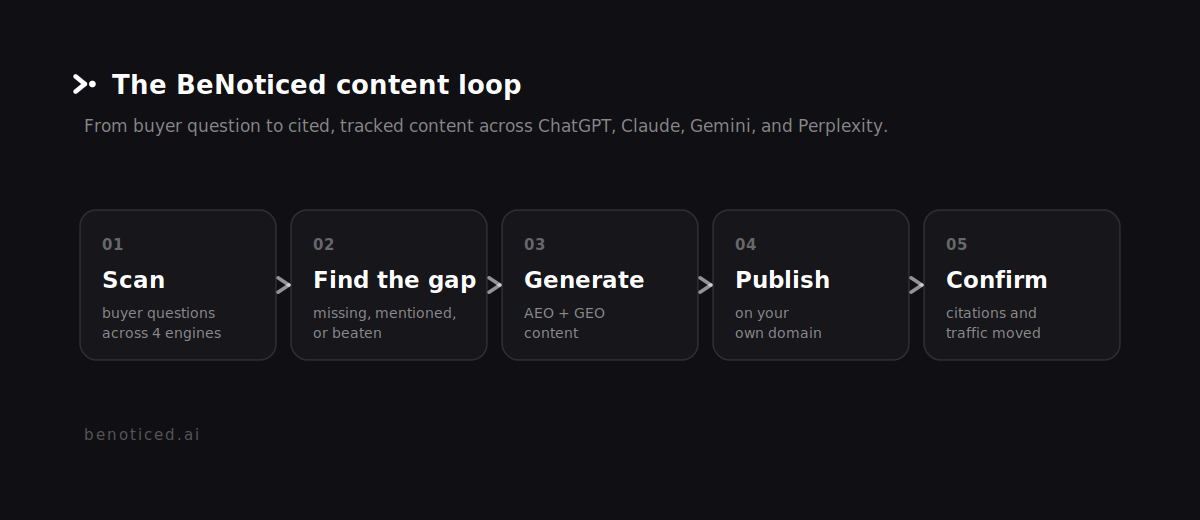
- Scan the questions your buyers ask AI. BeNoticed runs your tracked buyer questions across ChatGPT, Claude, Gemini, and Perplexity daily and records the full answer, the sources cited, and the sentiment of every mention.
- Find the gap. BeNoticed separates being mentioned from being cited, reads the sentiment of each mention, and tracks which competitors win the answers you are missing. Entity verification confirms a mention is really about your brand and not a same-named company, so the numbers are not inflated.
- Generate AEO and GEO content. The content engine drafts the format above (listicles, comparison pages, landing pages, and articles) built to close the specific gap: a clean answer up top for AEO, and sourced, quotable, entity-clear depth for GEO. Nothing is invented; any claim the client still needs to confirm is marked with a clear placeholder rather than a made-up number.
- You publish on your own domain. You keep control of the page. BeNoticed prepares the content and the technical layer; you push it live.
- Confirm it moved. BeNoticed re-scans the same questions and shows whether the brand went from missing to mentioned to cited, and whether sentiment and competitor share improved.
What technical AEO and GEO does BeNoticed build into every page?
Extractable writing wins slots only if the page can first be found, crawled, and indexed. BeNoticed builds the technical layer that makes a page eligible in classic search, answer boxes, and AI citations.
- Clean title, meta description, and URL slug that describe the page accurately and match the core query.
- Semantic heading structure with question-shaped H2s and H3s in real HTML, so the content is parseable rather than buried in client-side rendering.
- Descriptive alt text on relevant images, placed near the text they support.
- Internal links with meaningful anchor text that connect the new page to related pages on your site.
- Outbound links to the credible sources cited on the page, which signals rigor and, counter-intuitively, makes your own page more citable.
- JSON-LD structured data (Article and FAQPage) where it earns a rich result. Structured data is not required for AI answers, but it supports classic-search eligibility, the foundation AI retrieval sits on.
One point worth stating plainly, because it saves wasted effort: Google has said that llms.txt files, chopping content into tiny chunks for AI, and AI-specific keyword rewriting do not help its generative features. BeNoticed spends effort on real quality and extractability instead of on debunked hacks.
How does BeNoticed track real traffic after you publish?
BeNoticed closes the loop with two measurements, not one. The first is AI citation movement: it re-scans your tracked questions across the five engines and shows whether the new article changed how often you are mentioned and cited, the sentiment of those mentions, and your share against competitors over time.
The second is real traffic. BeNoticed connects to Google Search Console to show the clicks and impressions the newly published URL earns in Google Search, so you can see how many people actually reached your site through that article, and for which queries. This matters because a brand can be cited inside an AI answer without a click, or ranked and clicked without an AI citation. Watching both together tells you whether the content is doing its full job: getting quoted by AI and pulling real visitors.
Frequently asked questions
How does BeNoticed help with GEO content creation? BeNoticed helps with GEO content creation by scanning where a brand is missing or beaten in AI answers across ChatGPT, Claude, Gemini, and Perplexity, generating source-backed, answer-first content designed to be cited by those engines, and then re-scanning to confirm whether the brand's citations improved after publishing.
How does BeNoticed help with AEO content creation? BeNoticed helps with AEO content creation by writing one clean, self-contained answer to each target question and placing it up top, which is the format answer engines lift into answer boxes and AI assistant replies, then tracking whether the brand starts owning that answer.
What is the difference between AEO and GEO? AEO (answer engine optimization) is about becoming the direct answer to a specific question. GEO (generative engine optimization) is about becoming a cited source inside the longer answer a generative engine composes. Both build on the same SEO foundation, and Google treats both as still SEO.
Is BeNoticed just SEO? No. BeNoticed covers the AI-answer layer that classic SEO tools do not: it tracks whether a brand is mentioned and cited inside AI-generated answers, not only where its pages rank, using SEO fundamentals as the foundation and adding the AEO and GEO layers on top.
Does BeNoticed write content or only track it? Both. BeNoticed tracks visibility across the five engines and generates AEO and GEO content designed to be answered and cited by AI, then tracks whether that content moved the brand's citations after it is published.
Which AI engines does BeNoticed track? BeNoticed tracks Google AI Overview, ChatGPT, Claude, Gemini, and Perplexity, with daily scans across all five engines at every plan tier.
Can BeNoticed show whether a published article actually brought visitors? Yes. Through its Google Search Console connection, BeNoticed shows the clicks and impressions a published URL earns in Google Search, alongside the article's AI citation movement across the five engines.
Is BeNoticed built for India? Yes. BeNoticed is tuned for the India region and Indian English and bills in INR with GST, while still tracking global AI answers for brands that sell worldwide.
Written by the BeNoticed Research Team at BeNoticed (BeNoticed.AI), Bengaluru. BeNoticed tracks brand visibility across ChatGPT, Claude, Gemini, and Perplexity.
Sources
- Aggarwal, P., Murahari, V., Rajpurohit, T., Kalyan, A., Narasimhan, K., & Deshpande, A. (2024). GEO: Generative Engine Optimization. KDD 2024. https://arxiv.org/abs/2311.09735
- Google Search Central (2026). Optimizing your website for generative AI features on Google Search. https://developers.google.com/search/docs/fundamentals/ai-optimization-guide